
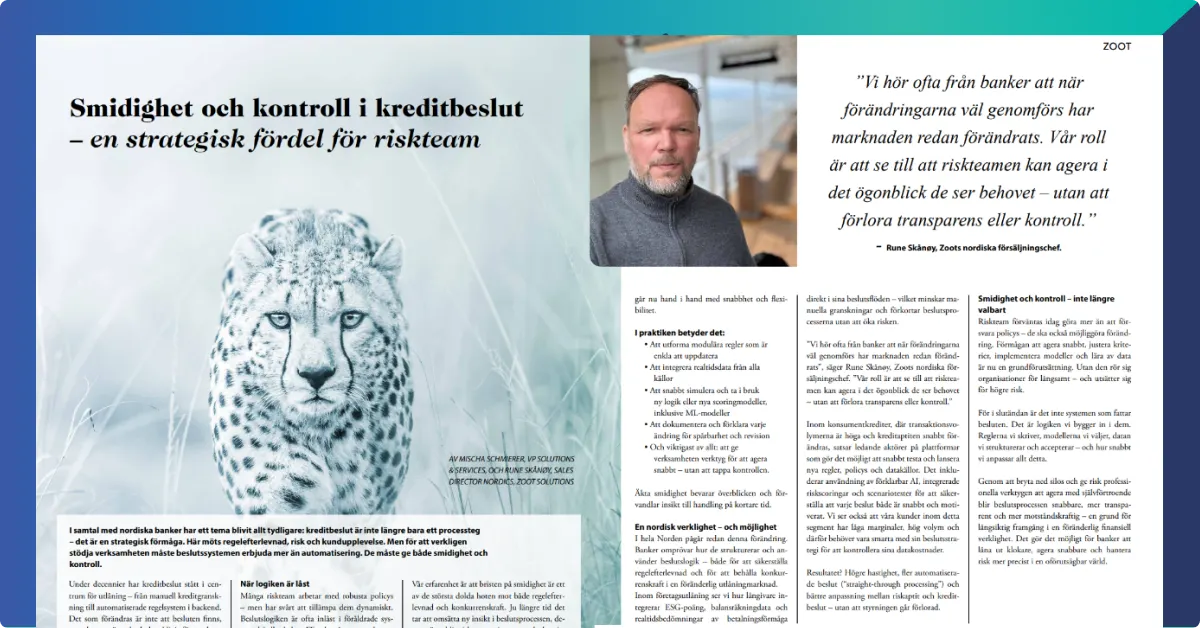
Agility and Control in Credit Decisioning – A Strategic Advantage for Risk Teams
Abstract
In recent conversations with Nordic banks, one theme has become increasingly clear: credit decisioning is no longer just a process step—it’s a strategic capability. It is where compliance, risk, and customer experience converge. But for it to truly support the business, it must offer more than automation. It must offer agility and control.
For decades, decisioning has formed the core of lending—whether it was a manual credit review or an automated rule set in a back-end system. But what’s changing is not the presence of decisioning, but how central it has become to managing uncertainty and enabling competitive speed.
In a regulatory environment shaped by DORA, ESG, evolving legislation around risk assessments and customer affordability, AML, and rising expectations around customer experience, the pressure to make better decisions faster has never been greater. That’s why agility now matters just as much as control
When the Logic is Locked Down
Many risk teams work with robust policies—but struggle to apply them dynamically. The decision logic is often locked in outdated systems, deeply coded by IT, and difficult to update. This limits the organisation’s ability to respond quickly—whether to new insights, changing risk patterns, or updated compliance requirements.
How fast can a team adapt affordability thresholds based on new analytics? Can new rules from the latest ESG scoring model be deployed in hours—or is it still a multi-week process? Can machine learning models be introduced without triggering rework across several systems?
In our experience, lack of agility is one of the biggest silent threats to both compliance and competitiveness. The longer it takes to reflect new insight in your decisioning, the greater the exposure to risk—and lost opportunity.
From Black Box to Strategic Lever
Decisioning must evolve from being a hidden, hard-to-reach function to a transparent, testable, and fast-moving strategic lever.
This means giving risk and credit teams—not just developers—the ability to both control and change decision logic with speed and confidence. It’s not about bypassing governance—it’s about enabling responsiveness within it. This means giving risk and credit teams, alongside developers, the ability to control and adapt decision logic quickly and confidently. Governance remains intact, but now it works hand in hand with responsiveness.
In practice, this means:
- Designing modular rules that are easy to update
- Integrating real-time data across all sources
- Simulating and deploying new logic or scoring models quickly, including ML models
- Documenting and explaining every change for auditability
- And most importantly: giving business users the tools to adapt fast—without compromising control
Agility doesn’t mean lack of oversight. It means shortening the distance between insight and action.
A Nordic Reality – and Opportunity
Across the Nordic region, this shift is already happening. Banks are rethinking how they structure and deploy decision logic—not just to satisfy regulation, but to compete in a dynamic lending environment.
“In SME lending, we see lenders integrating ESG scores, balance sheet data, and real-time affordability assessments directly into their decision flows—reducing manual reviews and shortening time-to-decision without adding risk.
In consumer lending, where transaction volumes are high and credit appetite shifts quickly, leading institutions are moving toward platforms that allow them to rapidly test and launch new rules, policies, and data sources. This includes using explainable AI, integrated risk scores, and scenario testing to ensure that every decision is both fast and justifiable.”
The result? Greater speed, higher straight-through processing, and better alignment between risk appetite and lending decisions—all without losing governance.
Agility and Control – No Longer Optional
Risk teams today are expected to do more than defend policy—they must also enable change. The ability to act fast, adjust criteria, implement models, and learn from performance data is now a baseline capability. Without it, organisations move too slowly—and expose themselves to greater risk.
Because at the end of the day, it’s not systems that make decisions. It’s the logic we embed into them. The rules we write, the models we choose, the data we accept—and how quickly we adapt all of the above.
When that logic is both controlled and agile, decisioning becomes more than just a gatekeeper. It becomes a growth driver—empowering banks to lend smarter, respond faster, and manage risk more precisely in an unpredictable world.
KREDITNYTT ARTICLE
Svenska Kreditföreningen tillvaratar näringslivets intressen inom kredithantering

Adam Jackson
Managing Director
Zoot Solutions
Additional Resources

5 min read

12 min read
3 min read
Stay up to date
Subscribe to our newsletter